Geekbat Tunes

Wednesday, November 9, 2011

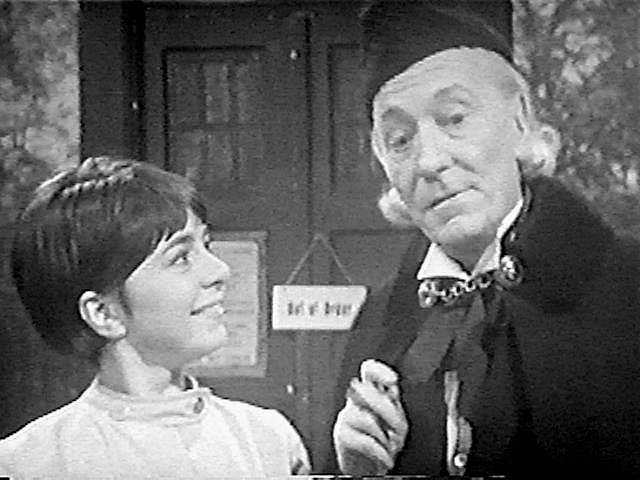
William Hartnell


Ah, William Hartnel. The First Doctor. THE Doctor. Famous for his crusty, grandfatherly manner. Even more famous for his repeatedly flubbed lines. Due to an illness. That was undiagnosed. And probably killed him.

So it's not so funny to laugh at anymore.

(Due also to the BBC not having the time or money to do multiple takes, so it was recorded practically as if it were live.)

He was funny, at times endearing. He was grumpy, at times block-headed. He had a funny little cackle, and a very particular pursing of the lips. He was my Halloween costume last year. He often claimed to be human. He had a mysterious signature signet ring, along with a monocle- possibly the most awesome accessories a sonic-screwdriver-less Doctor could have. He had power over hypnosis and the ability to mimic voices flawlessly.

He was my favorite.

Don't get me wrong, I still love David Tennant's Tenth Doctor, and if he hadn't gone through his manic-depressive-emo phase (I.E. The Gap Year) he might still retain that spot. But as of now, having viewed the First, Second, Ninth, Tenth, and Eleventh Doctors, I think it's safe to call him my current favorite. That may change, admittedly... but he will always hold a high ranking in my estimation.

He was the first, without whom there would be no other Doctors.

He was the original, the authority, the one that held it all together.

He was the Doctor.

And he will be missed.


My Top 10 Favorite First Doctor Moments
10. Trouncing an assassin (The Romans):
The Doctor takes to impersonating a musician that the group finds dead (for his own safety), not realizing that the dead man was the target of an assassination, and the group he’s fallen in with are determined to keep trying, believing that their initial attempt failed and the Doctor is their still-living target. A mute assassin is sent to stab the Doctor in his sleep as the group stops at a tavern for the night- and the Doctor handily thrashes him, throwing the man around the room with an almost carefree and disinterested ease, not even for a moment concerned for himself. This physical display, and the extreme confidence accompanying it, suggesting this to be merely the tip of the iceberg of the feats that the Doctor is physically capable of, is as surprising to the audience as it is to the assassin, and Hartnell’s bravado through it all really makes it stick in your memory.

9. Resigned Trojan horse proposal (The Myth Makers)
Captured by the Greek armies and coerced into finding a way to breach the unbreachable walls of Troy, the Doctor steadfastly refuses to consider the Trojan Horse as an option, believing it to be a historical myth- here, he has an opportunity to craft, and discover, how Troy really fell. After a series of far-fetched proposals, Steven again suggests the well-known horse, and the Doctor soundly rejects the notion, instead briefing the commander on his final proposal: catapult-launched hang-gliders. The skeptical general agrees, but informs the Doctor that Hartnell will be the one made to test, he will be the first launched on the ridiculous contraptions. Faced with the prospect of riding on his own lethally-absurd creation, the Doctor calls the general back and, ever so reluctantly and with great resignation, suggests a giant wooden horse instead. Hartnell’s performance- from stubborn refusal to begrudging acceptance, makes this one of the most hilarious of Myth Maker’s many laugh-riot scenes, even through the stills of a reconstruction.

8. “DO… NOT… KILL!”/The Double Fight (The Dalek Master Plan):
The strange clearly-not-identical-doppelganger-stunt-double plot comes to a head in the penultimate chapter of the Dalek Master Plan, as the Doctor and his double fight- itself a rare and exciting fight-scene moment for Hartnell, its memorability is enhanced by his unique solution- another use of his vocal mimicry skills to imitate the Daleks’ halting speech and order the robot not to kill, causing it to hesitate long enough to defeat it (admittedly, I find it memorable especially because I didn’t understand what he was doing, and found his odd-cadenced yell to be oddly hilarious)- a scene enhanced by Hartnell’s double-duty roles, and the way that the imposter is discovered- referring to Vicki as ‘Susan’ (recently departed) because the robot’s programmed information was out of date. Definitely one of the Doctor’s most memorable confrontations.

7. Beating the Toymaker (The Celestial Toymaker):
Coming at the climax of a serial in which the Doctor is seldom seen, the titular villainous Toymaker has put the Doctor and his companions through their paces in his sinister games, and they have triumphed. There, on the stage of his final defeat, the Toymaker appears and admits that he is a sore loser- one game has yet to be completed, until which time the TARDIS crew cannot leave- and making the final move will instantly destroy the world which they inhabit, leaving them the choice of eternal imprisonment, or perishing in a pyrrhic victory. Yet the canny Doctor, who has managed to irritate and confound the far-more-powerful Toymaker at every turn, has a trick up his sleeve, turning the Toymaker’s own voice-command system back on him to complete the final move (after a false-start in which his first attempt fails, leading the overconfident Toymaker to smirk in derision) from the safety of the TARDIS, dematerializing it at the last second. It’s a brilliant and well-written gambit, the solution of which had been hinted at, like the great murder mysteries, subtly throughout the serial for those that had been paying attention. It’s a great use of the First Doctor’s unique voice mimicking capabilities. It’s a brilliant and very satisfying comeback as the Doctor utilizes the tool used to intimidate and bully him throughout the serial to have his cake and eat it, too. And his look of victory as he begins his escape makes it all the better.

6. Accidental engagement (The Aztecs):
The Doctor has been growing close to the elderly retiree, Cameca- a closeness that means more to the kind and gentle Aztec woman than it does to the oblivious Doctor. When she offers him a cup of cocoa and he accepts- ignorant of its cultural significance and simply finding the prospect of some Hot Chocolate delightful- he finds a little more than he bargained for when she exclaims with joy about their new betrothal. The expression on the Doctor’s face simply has to be seen to be believed- and the comedy of the scene and wonderful character created in Cameca makes their eventual parting all the more tragic.

5. Farewell speech to Susan (The Dalek Invasion of Earth):
It’s shown at the beginning of specials for a reason. This was the first companion departure, a resolute but sad forced-departure of the Doctor’s own flesh and blood. Hartnell is tender and wistful as he makes the decision, but puts on a brave face for Susan, urging her to go forward and claim the life that she deserves. He gives the speech all the gravitas, regret, tender care, and loving, grandfatherly wisdom that such a moment deserves, and the result is mesmerizing. “One day I shall come back. Yes, I shall come back. Until then, there must be no regrets, no tears, no anxieties. Just go forward in all your beliefs, and prove to me that I am not mistaken in mine. Goodbye, Susan.”

4. Failed Interrogation (The Space Museum):
The conquering authorities are trying to sweat the Doctor out in an interrogation, but he doesn’t seem to be worried in the slightest. The authorities, greedy for the secret of the TARDIS, haul out their big guns: a mind-reading device. They hook Hartnell up to it and fire away their question once again: “How did you get here?” There’s no way out of it this time! But the Doctor proves that he still easily has the upper hand, as the screen lights up with a picture of an old-timey giant-wheeled bike. Then, as the interrogators stare in shocked disbelief, he cackles with delight; though he’s in handcuffs, captured, and being interrogated, Hartnell is still firmly in control.

3. The Unintentional Hold-up (The Gunfighters):
Seldom has the Doctor (mistaken for Doc Holliday by vengeful Clantons) been so out of his element- believed to be a crack-shot (an illusion aided by an unseen shooter and bolstered by a deceptive saloon girl), the Doctor ends up in a Stetson, six-shooter in hand, holding up the three Clantons he’d just been trying to talk down. You can see written on his face the simultaneous excitement (really getting into being a cowboy, and loving it), and complete fish-out-of-water bafflement and fear; now that he’s got ‘em, he has no idea what to do with ‘em, and has to ask the Saloon girl what’s next. It’s one of Hartnell’s funniest scenes.

2. “I am that man!” (Keys of Marinus):
After a prolonged actor-vacation absence, the Doctor made his entrance into the courtroom drama of the final Key location just as Ian was bemoaning the need for a man that could stand with him, against the potential of sharing his punishment, to defend him at trial. With this pronouncement, the Doctor made his first truly heroic entrance, a save-the-day moment for the Doctor like those we’ve come to know and love, and finally started to demonstrate care and solidarity for the companions that he had, up until this time, treated more like unwanted baggage.

1. Confronting Koquillion (The Rescue):
In a fantastic moment that (even as of the Fourth Doctor’s second season) has been rarely matched, the Doctor has a true showdown with the villain of the piece, one-on-one. He confronts Koquillion in a dark, atmospheric ruined temple, fragmentary remnants of the society upon which he had committed genocide- keeping his back turned as Koquillion enters, the Doctor will not even look at him as he spins the tale he’s managed to work out, reconstructing the events of the past there in the moody, misty remains of a once-proud civilization. The resulting fight- with explosions about and dangerous chasm-edge battles- is cinematic and epic, yet very personal; this is a classic finale, brilliantly filmed with fantastic cinematography, and feels worthy of a major motion picture Doctor debut.
(As a side note, I am so proud of myself- it’s been a year since I’ve seen this, and I spelled Koquillion right from memory!) :-)


Also, here are a few honorable mentions that didn’t quite make my top 10 list, but I feel are worthy of notation for their distinctiveness:
The Backgammon matches from Marco Polo (notably the first time we really see the Doctor taking center stage and trying to save the day), outsmarting the chain gang in Reign of Terror (a great comedic scene), confronting the Monk (I always love seeing those two together), and the grueling Time Destructor standoff/march (another of the Doctor’s most memorable confrontations, and an incredibly powerful finale) in Dalek Master Plan, and facing down the oncoming War Machine in The War Machines.

Tuesday, November 1, 2011

Doctor Who: The Tenth Planet


Serial Title: The Tenth Planet
Series: 4
Episodes: 4
Doctor: William Hartnell
Companions: Ben Jackson (Michael Craze), Polly Wright (Anneke Wills)


Synopsis:
It is 1986 (the future, at the time) and the International Space Command is trying to manage an orbital launch of the Zeus II capsule and its astronauts from the Antarctica ‘Snowcap’ base… when a Police Box appears out of nowhere, expelling three passengers, and sending the secure military base into an uproar. General Cutler, the commanding officer, interrogates the newcomers, but is soon distracted as an unknown force is buffeting the Zeus II, heralding the arrival of a new bright point in the sky… the planet Mondas, which appears to be nearly identical to Earth, except for being upside-down (which is 60s hokum, since up and down are rather meaningless in space anyway). The Doctor has predicted these events in advance, for he already knows what occurs on this historical date…

The base is invaded by Cybermen, metallic beings from Mondas- cyborgs who have transferred their living minds into machines- losing their emotions and humanity in the process- in order to survive harsh conditions. They take captive all of the humans, who are forced to watch helplessly as the Zeus IV is destroyed by the gravitational forces of Mondas and Earth’s interaction. (Note from Sarah: I get that it's all about survival, but I do think it's funny the lengths people will go to survive in Sci-fi when they won't even realize they are surviving in the first place really, I just wonder what the point is.) Ben is imprisoned in the projection room for the base’s theater, and the Cybermen reveal their intentions- Mondas is dying, having left its orbit and flown all around the galaxy, expending its energy… now, they have returned to their solar system of origin, and they intend to leach the energy from their compatible sister planet (Mondas once shared our orbit, on the other side of the Sun from us), destroying Earth in the process. But the Cybermen are not entirely heartless (Well… yes, they are, actually, in every sense of the word…), and offer the humans survival via coming to Mondas and being made into Cybermen.

Ben uses the projector in his room to blind and overpower a Cyberman, stealing his weapon (which is also, ironically, a light. Say, you don’t think Steven’s bright idea to replace the life-force-draining-of-cavemen was Cybernetic implants, do you? We never learned the time or place of The Savages… it could well have been pre-historic Mondas!) and is forced to kill him with it when the Cyberman attacks, a decision he deeply regrets. It does, however, earn him kudos from General Cutler- using the stolen weapon, they slay the occupying Cybermen. Cutler has bigger concerns, though- before the Zeus IV’s destruction, a rescue capsule was launched… the volunteer being Cutler’s son, Lieutenant Terry Cutler, whose capsule, the Zeus V, is now threatened with the same destruction that the Zeus IV fell to.

Cutler plans to launch the powerful and deadly Z–bomb at Mondas, hoping that the doomsday weapon could obliterate Mondas with its incredible explosive power- millions of times that of an atomic bomb. However, the resulting radiation at this range would likely sterilize whichever half of the Earth was facing it, killing untold billions. The Doctor urges patience, insisting that Mondas is not prepared for the power it is draining, and will overload itself and burn out, returning the energy to Earth- they will cause their own destruction. However, as he tries to press the issue, the Doctor collapses of exhaustion- the energy drain from Mondas also slowly draining away his life-force (NFS: Why...exactly does it do that? How is he connected to Mondas...that's silly.). As Polly looks after the Doctor, Ben looks towards stopping the launch of the Z-bomb, which Cutler- disobeying orders and slowly descending into madness out of fear for his son- intends to launch, needlessly (if the Doctor is correct) killing billions. Sympathetic Doctor Barclay, another member of the Antarctic base who does not want global genocide, helps Ben, telling him how to disable the Z-bomb rocket, which is housed on-base (!). Ben is found by Cutler, attacked, and imprisoned before he can complete his task.

More Cybermen land, and are annihilated by the captured weapons. The countdown for the Z-bomb commences as the Doctor and Ben awaken, and can only watch in trepidation… (This was an excellent cliffhanger, by the by!)

The Rocket fails to launch- Ben’s sabotage was far enough along to prevent it before he was interrupted. (NFS: COP...out.) Cutler goes insane- also believing his son to be dead- and prepares to kill the ‘traitors’- but a third Cybermen invasion hits the base, and Cutler is killed. The Doctor and Polly are taken prisoner, led to the Cybership to be converted into Cybermen themselves…

Mondas gorges itself and doesn’t feel so hot afterwards, breaking up and burning out, just as the Doctor predicted. The Cybermen, deprived of the energy provided by Mondas that powers them, collapse, inert and dead. The Zeus V is guided home (where Lieutenant Terry Cutler will find out that his mission failed, his colleagues died in space, and his father was just killed… poor kid! Like Spider-man’s John Jameson, it’s not his fault that his dad’s a jerk, but life keeps sucking for him because he acts heroically… And don’t even get me started on what Mary Jane does to him in Spider-man 2…!)

Ben leaves the base to go and rescue the Doctor and Polly, but the Doctor is weak to the point of collapse again, babbling and feverish, his life leached away by Mondas and his old body failing him… he stumbles into the TARDIS one last time, de-materializing the ship, and collapses to the floor. As Ben and Polly watch, his features glow, then emit a blinding light… and fade away to reveal the features of a younger, different face. (NFS: Plus hotter. :-D)


Review:
You can't be this stupid on purpose. It takes effort to fail so heavily. The one missing episode of this serial IS THE FIRST EVER REGENERATION EPISODE?!?!?! 

That said, this is an interesting serial with an interesting set of guest characters. While the future predictions are problematic (yup, we just landed a man on the moon for the first time... in 1986! Hardly Star Trek’s prophetic Moon Landing date prediction, here…) and the sci-fi plot is questionable (see, the upside-down Earth duplicate that used to share our orbit flew off into space, ran out of energy, converted its people into emotionless cyborgs, and now it's back to somehow suck our energy into them, only they botched it and it's gonna blow up their planet anyway, we just have to wait for it... what, why are you looking at me like that?), the story- and the setting- remain interesting, more a thriller about a doomsday missile launch a la Crimson Tide (with bookending Cybermen-invade-the-base opening and closing) than anything, with Mondas and all of its questionable backstory as one great big inhabitable Macguffin.

Okay, so the general was a little nutso- but as the Tenth Doctor's (and probably many others) era would prove, if Who is going to show the military (except in WWII, because even hippie-peacenick-military-haters can't badmouth WWII), they're going to be stereotyped blood-hungry, violent cardboard cutouts that kill because THEY ENJOY IT.

By that standard, this guy is practically nuanced.

Meanwhile, the lead scientist is a multi-dimensional character and sometime-ally with fears and foibles all his own.

The Cybermen are well-played, with a good design (well, minus those ski-masks), an excellent voice, and a good, very chilling, efficient, emotionless characterization- going about their pre-planned business even as everyone around them is asking agitated questions- pausing just long enough to answer and then returning to their business. While a few times they slipped and seemed a little too 'human'- such as the Cyberman lured into to Ben's projector trap- overall, they came across very strongly, making an excellent first impression (one that would sadly not last, as they were rather a joke by the 7th Doctor's time, I think- now considered second-fiddled low-rent alternatives to the Daleks- which their inferior physical strength vs. the Daleks in the new series hasn't helped. However, at this time of their introduction, they are quite the equal to the Deadly Pepperpots, and... dare I say it? ...A good deal more nuanced, better characterized, and to me, more menacing than their more famous, less limbed, extermination-obsessed cousins in villainy. (NFS: Plus they have a cooler backstory)) and a strong villain- even if, surprisingly, this story is really more about the human villains and a prolonged battle of wits- with the Cybermen serving more as the driving force than the primary antagonist, save for bookending invasions.

The notion of a planet on the other side of the sun, exactly in our orbit but always with the sun in between us and them so that neither knows the other exists, has been a part of science fiction since it was first written by Sir Philip of Bristolshire in the trenches of the third crusade in 1188 A.D. (though all film portrayals of Sir Philip since the 1990s have, of course, portrayed Philip as a condescending, ignorant war-monger who stole the concept from the noble and peace-loving Turks and their advanced culture.) Regardless, it’s yet another sci-fi convention that has been around since before the dawn of sci-fi, is older than dirt, and yet again is used by Doctor Who as a setting for their story instead of the story itself. This is a talent of Doctor Who (as I will again note in 'The Macra Terror' when we get there)- they take hoary old sci-fi clichés, but they don’t use them as a story, they just use them as an element of the story, a familiar convention that’s been done to death a backdrop for the story to play out against, building on it and expanding upon it. And at least this planet-on-the-other-side-of-the-sun story is FAR less depressing than “The Planet On The Other Side Of The Sun”- even WITH the rampant deaths and the loss of Hartnell.

Man, that was one depressing movie.

As for the characters…
Polly... makes coffee. In fact, she isn't even told to by some condescending military man who doesn't realize what she has to contribute to the situation... she offers to.
That's about it. (NFS: wellll....she looks after the Doctor too...I mean...that's something right?)

Ben is pretty much the protagonist. An active, kicking-tail-and-taking-names, bomb-sabotaging, gun-stealing, film-projector-weaponizing type of protagonist who really has an extremely strong showing- and his military training and youthful energy are contrasted well with his remorse for having been forced to kill... if that had been an attempt to show a 3-dimensional military man instead of the more likely oh-yeah-we-forgot-he-was-in-the-navy-this-is-just-what-companions-do scenario, I'd be impressed. Either way, Ben gets about as much action and development in this serial as some companions got in their whole run- heck, more-so than Susan or Dodo! (NFS: Was that supposed to be a joke??? A dead Quark gets more action than Susan or Dodo!)

The Doctor doesn't have much to do, at times- an intentional writing bit to account for Hartnell's failing health and the possibility of his unavailability- one seen in action by his collapse and absence from the third episode... which, factoring the forthcoming regeneration, could have been more smoothly incorporated as foreshadowing. Regardless, this sudden 3rd-episode-absence renders the story a bit uneven and confused. Even so, the Doctor remains strong and principled, and a stalwart presence in his final serial, even if he is less of an active story component than usual.

And that brings us to the regeneration itself. For the first time, the Doctor has regenerated- and the face that we, Ben, and Polly know and love will never- save for crossovers- be seen again.

The foreshadowing is not there the way it ought to be, and the reasoning (since clarified to be the energy drain from Mondas affecting him coupled with weakening by exposure to the Time Destructor (The Daleks Master Plan) and a life-force drain (The Savages)) is not especially clear. And the loss- due to filming schedules- of Hartnell's dramatic final line- "I shall not give in... I shall never give in!" is unfortunate. (NFS: Oh...so that's how they explain him losing energy-okay) It would have been a GREAT line.

Yet, for all of those flaws... it is a powerful moment! A throbbing, powerful soundtrack that doesn't descend into cacophony, a building inter-cutting of shots that comes through even in the stills version, and a sense of mystery, coupled with the tragic-yet-hopeful (to those of us in retrospect that know what's happening, of course!) prone form of Hartnell on the TARDIS floor all combine to make the first regeneration a tour-de-force powerhouse even in its fragmentary state, a testament to the excellent work that went into crafting this historic television moment! It is a worthy handoff, a sterling sendoff, and a tragic farewell to a beloved actor all at the same time- it exceeded my expectations, and was all that anyone could ever ask for to usher in the era of Patrick Troughton. And it is also farewell to the first, the original, the only William Hartnell, the Doctor, a beloved figure and an iconic originator.

And as to the reconstruction... much as its necessity galls me, it is very well-constructed, shrunk to 3/4 screen size and shown atop an ever-moving radar screen (an element from the episode) that gradually and subtly changes color- it gives a needed sense of motion and variety which helps to spice up the plentiful stills. The regeneration itself exists as video only for the face-fading shot itself (a happy accident of overexposure inspiring the video editor to use this technique- otherwise, we would have had the far less powerful, ultra-cheesy, not-fitting-at-all ending of Hartnell collapsing face-down with his cloak over him, and the cloak being lifted to reveal Troughton at the beginning of the next serial)- but again, the reconstruction is expertly edited- along with the soundtrack, while the loss of motion video is unfortunate... you hardly miss it.

Though it doesn't feature the photo-trickery or CGI Daleks or manipulated elements that some other reconstructions have had, this one's style makes it top-notch.
(As an aside, for those interested there is also an excellent 3D-model reconstruction available on Youtube.)

Great moments:
The Regeneration – a cliché choice, but oh-so-true! The first appearance of the Cybermen is pretty classic, too.

Rating:
4 out of 5 Deadman's Keys to this serial- lowered to 3 by the uneven tone, but raised to 4 simply on the strength of that fantastic regeneration and the excellent Cyberman origin episode- and 5 out of 5 for the polished reconstruction.
(NFS: Can I just say I am so excited to be going into the Patrick Troughton era??? I will probably have a lot more to say on those!)

Monday, October 24, 2011

Doctor Who: The Smugglers


Serial Title: The Smugglers
Series: 4
Episodes: 4
Doctor: William Hartnell
Companions: Ben Jackson (Michael Craze), Polly Wright (Anneke Wills)


Synopsis:
An irritated Doctor deals with Ben and Polly’s sudden appearance in the TARDIS, and then further with their skepticism that they have been shanghaied through time and space. Returning to England, on the shore, the two are forced to believe him as they enter a small church and find out from its caretaker, Longfoot, that they are in the 1660s. Polly (mistaken for a boy with her short haircut and modern clothes), Ben, and the Doctor depart for the local Inn, but before they leave, the Doctor is entrusted with a riddle from Longfoot- “This is Deadman’s secret key, Ringwood, Smallbeer, Gurney.”

The travelers arrive at an Inn run by Jacob Kewper, who is initially suspicious of strangers, but welcomes them when he finds that they are friends of Longfoot. Speaking of the caretaker, he is interrogated and murdered by pirate thug Cherub over the location of a hidden treasure. When the body is found, the TARDIS crew, the self-admittedly last people to have seen Kewper alive, are prime suspects. As the Squire is sent for to arrest them, pirates, led by Cherub, break into the Inn and kidnap the Doctor, suspecting that Longfoot may have told him something. Ben and Polly are arrested moments later.

Cherub takes the Doctor to the Black Albatross, and his master, the notorious Captain Pike. The wheelchair-bound man is only capable of responding with a beeping, morse-code light from his motorized wheelchair, in what feels like a strange failing of 23rd century technology, which is somehow incapable of the same amenities- such as speech simulation- that we could grant modern individuals like Stephen Hawking in the 20th century… 

Sorry, my mistake. Wrong Captain Pike. (Note from Sarah: A wheelchair pirate could be pretty cool though...)

This Captain Pike is a bloodthirsty buccaneer and smuggler, a ruthless man with a deadly sharpened Pike for one hand. No, not a fish that has been honed to a razor’s edge, but a blade that has spilled the blood of many a man- foe and crew member alike. (Face it, there are too many different definitions of the word ‘Pike!’) There, the Doctor negotiates with and flatters Pike- but before he can make any significant progress, a rowboat approaches bearing Joseph Kewper, and the Doctor is hauled below decks, out of sight, while Pike talks with him. Kewper reveals that he, Longfoot, and the Squire are smugglers- well, Longfoot isn’t so much of one anymore, but still- and they wish to hire Pike. Pike threatens and rebuffs Kewper, setting off to find the Squire and deal with him directly.

Meanwhile, Ben and Polly escape by playing on the superstitions of Tom, the cowardly stable boy. They return to the old church, trying to find a clue about Longfoot’s true murderer… and find a man skulking about, whom Ben attacks and renders unconscious, binding him and sending Polly to fetch the Squire. The man regains consciousness, and is revealed to be Josiah Blake, a revenue officer of the King. Ben reveals a recently discovered secret passage in the church crypt- further evidence to Blake that the smugglers were operating out of it… but Ben refuses to untie him, doubting his identity, and upon the Squire’s return, he and Polly are arrested once more. 


They recognize Cherub (who, along with Pike, is still accompanying the Squire) as the Doctor's kidnapper, and realize that the Squire must be a smuggler as well, but Pike claims he is merely an honest businessman, for which there is no evidence to the contrary to support Ben or Polly’s claims.


The Doctor and Kewper, jailed together in the hold of the ship, likewise play off superstitions of their captor, the swarthy Jamaica, using a fake Tarot card reading (with a standard deck of playing cards, positing absurd interpretations of the ‘meanings’ of the various face cards drawn in interpreting the future) and manage to escape. Jamaica is killed by Pike upon his return.

Blake, taking Ben and Polly as his prisoners, frees them and reveals that he believes their story- he has suspected the Squire for some time, but has no evidence on which to arrest them. The Doctor arrives to rendezvous with them- but Kewper, seeing the revenue officer, believes he is betrayed and escapes at gunpoint, heading back to the Squire.

Pike prepares to attack the village, striking with two groups- one to steal the smuggler’s stash for themselves, and the other to find Avery’s Gold, the treasure Longfoot had stolen. The Doctor, feeling morally obligated and knowing that Pike will ravage the innocent village, takes Ben and Polly to search for the treasure, hoping that is can be used as leverage to force Pike to spare the town his usual pillaging. They decipher the riddle and locate the treasure… just as Kewper and the Squire arrive… shortly thereafter, so does the murderous Cherub, sent ahead, who kills Kewper. The Squire is wounded.

Meanwhile, Blake rides to the militia outpost for help.

The Doctor reveals the riddle, but not its solution, to Cherub, buying them time as Cherub works through the clues as they did. Pike arrives, his men looting the smuggling cache, and enters the crypt. There, he discovers Cherub, in the process of trying to take the treasure for his own, and the two duel. In the chaos, the Doctor dispatches Ben and Polly down the secret passageway, which leads to the beach, and the TARDIS.

Pike kills Cherub, but before he can kill the Doctor, Blake and his men arrive in force, attacking the pirates. Polly is attacked in the tunnel and rescued by Ben. Blake kills Pike, and the TARDIS crew escapes as the pirates are routed and the injured Squire has a change of heart due to the Doctor’s kindness towards him.


Review:
Arrrr, matey! Pirates of the Caribbean, this ain't. Fairly low-key for both a season-opener and a companion introduction...

Ben and Polly have a fairly nicely contrasted episode- starry-eyed belief (albeit without much of a sense of wonder) meeting a thick-headed skepticism that seemed slightly less believable than Steven's in the Meddling Monk. Still, both characters do fairly well- trying to be proactive (for once, among companions!) in a time where the rules are different and they are true fish out of water... their inspired witchcraft con was a nice bit, though the revenue man capture was fairly botched. Overall, both come off very favorably in their first TARDIS-outing.

The Doctor himself plays the manipulator to both sides, and has a clever Voodoo-gambit of his own (only the Doctor would try to give a pretend tarot-card reading with a regular deck of cards!) and comes off coolly unflappable, and very principled, staying in this time when he could escape, because he feels a sense of moral responsibility to help.

The story itself is a little slow, especially in the first two parts- but it's filled with enough twists and turns to keep it interesting. This serial, overall, is what I'd call 'adequate but unmemorable'- not terrible, but... not much to say about it, either.

It may not help that all four episodes were reconstructions- though nearly every death was in video, thanks to Australian censored clips that survived the Who-burning. The reconstruction was decent enough, a relatively standard fare, and pretty average. Nothing to impress with (like CGI-able Daleks, doors, or computers) but nothing disappointing, either. Like the serial, it is decent but doesn't distinguish itself.

Great moments:
The Doctor reads tarot cards with a deck of playing cards- making up a mysterious significance to the Queen of Hearts, the Jack of Clubs, etc.

Rating:
A hearty 2.5 out of 5 Deadman's Keys for both the serial and the reconstruction, mateys- a solid, middle-of-the-road average, just as they were.

Friday, October 14, 2011

Doctor Who: Series 3 Overview


...And this is it. The end of Series 3, the final full series with Hartnell. It was a lot more hit-and-miss than the 'Golden Age' of Series 2, with some epic highs but also some definite Galaxy 4s- I mean, lows. The centerpeice, "The Daleks Master Plan" was excellent, but the latter half- and opener- a slump. There were also far more missing pieces this series, though that's hardly the fault of the series itself, but of the BBC decades later.


While there were some some truly dull stories this season to a greater degree than before, the production values and budget continued to increase- from effect extravaganza's like the Time Destructor scene or the destruction of the Toymaker's world to physical props and model work like the War Machines- and some excellent guest actors.

The series recieved some much-needed companion humor in the form of Steven's dry sarcasm and perplexed looks- after all, the Doctor can't bear the entire weight of the comedy in the series! It also had what I consider to be Who's finest comedic serial to date.

Overall, I'd rate this one lower than Series 2- but also sowing some seeds that can hopefully be expanded in the Second Doctor's golden age- whenever that may be- to make it even greater than the First's.

Wednesday, October 5, 2011

Doctor Who: The War Machines


Serial Title: The War Machines

Series: 3

Episodes: 4

Doctor: William Hartnell

Companions: Dodo Chaplet (Jackie Lane), Ben Jackson (Michael Craze), Polly Wright (Anneke Wills)


Synopsis:
Landing in modern-day (1966) London, the Doctor and Dodo set out to explore, marveling at the newly-completed futuristic Post Office Tower… from which the Doctor immediately senses a sinister presence. Traveling to it, he discovers the newly-activated WOTAN (Will Operating Thought ANalogue (Note From Sarah: I always think it's cheating when people just decide that TWO letters are going to be in the little 'acronym' thing or that one letter isn't going to stand at all because then the 'acronym' thing wouldn't SAY anything intelligible. ), a supercomputer with unprecedented intelligence, able to answer any question- including, disconcertingly, the meaning of the acronym ‘TARDIS’ without any external information. It is the brainchild of professor Brett, a brilliant young scientist. 

Hypnosis Collect- will you accept the mind-control?
As Brett’s secretary, Polly, takes Dodo out for a night on the town at the Inferno Nightclub (where they meet a handsome but somewhat depressed young navy sailor named Ben Jackson), the Doctor attends a press conference on WOTAN’s unveiling, attempting to determine more about the machine. However, Brett soon arrives in a strange, robotic state- disrupting the meeting and spiriting away his employer to go and see WOTAN. There, he is hypnotized by the powerful computer, just as Brett has been. Soon, due to a phone call to the Inferno Club (WOTAN can hypnotize via phone lines), Dodo is too- her line of questioning, and the Doctor’s, having intrigued the machine.
Ben and Polly, with Dodo in the background where she belongs

Ben chivalrously (but hot-headedly and violently) comes to Polly’s aid against an aggressive suitor, and the two begin to spend time together- soon looking for Dodo, who has disappeared. Meanwhile, WOTAN makes plans- Dodo is recruited to get the Doctor under WOTAN’s control, while the rapidly growing force of hypnotized humans is divided into labor forces, compelled to construct War Machines with which WOTAN can begin to conquer the Earth. A homeless man is killed by the War Machine workforce when he stumbles into their warehouse.

WOTAN: Supercomputer


Dodo attempts to lure the Doctor into hypnotism-by-phone, but his mysterious Blue Signet Ring (NFS: Say...how do you know it's Blue when it's in black and white?) once again saves him from the full effects of a hypnotic attack, and he recognizes the effects of hypnosis in Dodo (NFS: I don't claim to be a hypnotist authority...but I feel that it shouldn't work over the phone anyways.). Sitting her down in the chair, he uses his signet ring and his vocal command to reverse the hypnosis, putting Dodo in a deep healing sleep and leaving her in the care of one of his Earth allies to recover. (Remember this moment for later…)

Polly is taken, and the War Machines march on to completion… Ben, searching for Polly, stumbles into the warehouse, and is spared from death only to be co-opted by Polly into the labor force- a slave instead of a hypnotic ‘volunteer’ as she is. The War Machine’s weapons are tested on another hypnotized worker, and the machine nears completion- a deadly gas spray and a crushing metal battering-arm only a few of the myriad implements of death adorning it’s armored exterior. Propelled by tank-like treads, the War Machine prepares to go out and sow destruction upon unsuspecting London.

Polly is at least in control enough to fail to sound the alarm as she spots Ben escaping- nevertheless, he is spotted, and barely manages to escape… reaching the Doctor and revealing the War Machine’s location. The Doctor, aware that this is only one of many, readies the police, who raid the facility- and are slaughtered by the relentless War Machine as it activates. The Doctor alone holds his ground, standing in the middle of the road to confront it… the War Machine breaks down from a programming failure, having been activated before it was fully ready. Based on an examination of the Machine, the Doctor begins to work on a way to immobilize them.

War Machines are launched all throughout the area, and the Doctor prepares an electromagnetic trap of cable to paralyze the device- a trap that must be manually closed, a task Ben bravely volunteers for. The first active Machine is caged in by magnetized cables; it can’t escape, and the Doctor shuts it down- reprogramming the machine quickly, and then releasing it.

Ben charges to the Post Office Tower, WOTAN’s headquarters, and finds Polly- dragging her forcibly out just moments before the Doctor’s reprogrammed War Machine barrels in and attacks WOTAN, obliterating it, and freeing the victims of hypnosis from WOTAN’s control.

Later on, the Doctor stands outside the TARDIS, waiting for Dodo’s return… he is instead approached by Ben and Polly, who convey a farewell from the convalescing Dodo, who wishes to remain behind. The Doctor, outraged, incensed, and hurt, huffs angrily into the TARDIS as Ben and Polly leave. At the last moment, however, Ben remembers a dropped TARDIS key, fallen from the Doctor’s pocket as he confronted the first War Machine, which Ben had forgotten to return to him. He opens the TARDIS door with it, and he and Polly step inside to return the key… seconds later, the TARDIS dematerializes with them inside.


Review:
This one felt very different. An odd Season Finale (not necessarily intended to be, apparently)- it feels both epic (in it's high-quality, massive props and on-location shooting, which is so real as to make things seem almost unreal, in some ways) and small (in it's limited scope of storytelling up until the very end)- but I think the former feel dominates the latter. It's traditional sci-fi backed with a high budget. Does that equal a winning combination?

Well... besides appearing that they broke the bank on the War Machine props, with their gas-guns and weighted-stop-signs-of-doom, they also had an interesting concept- a computer whose spooky near-omniscience (How DID it know what TARDIS meant? They never explained that...) apparently doesn't extend to getting the Doctor's name right. Oh, and it uses phone-hypnosis to recruit an army to build war-machines to take over the world. It seemed like- barring the question of where it got hypnosis powers- a pretty plausible method for a non-mobile computer intelligence to gain control in the physical world... something sci-fi doesn't always pull off (I'm looking at you, Eagle Eye...). The real-world location of the Post Office Tower in London is so unique and well-designed, (NFS: It's the same building that they turned into a lightsaber for the Star Wars Blu Ray releases and now I can't look at it without thinking it looks like one) it looks like a sci-fi building cleverly inserted into the skyline seamlessly- an excellent location. And the credits people even got cute and added WOTAN to the end credits as himself.

On the other hand, certain bits felt a bit abrupt- most notably Dodo's departure, which I'll get into... the Doctor was underutilized- save for his excellent counter-hypnosis, brave stand against the advancing War Machine, and his supervising of a War Machine capture, it felt as if he didn't have much to do here- the emphasis being on Ben and Polly instead (a common theme for the rest of his episodes, due to Hartnell's declining health.) And a personal fascination of mine, the Doctor's blue signet ring, shown to be hypnosis-resistant and even counter-hypnosis capable, and presumably the cause of Hartnell's  resistance to WOTAN's mind control, barely gets a nod here.


Plus, as minor quibbles, half the folks seem to pronounce the villain's name, inexplicably, as "Votan"- not a little slur, but a very clear, conscious "V" sound... and WOTAN itself repeatedly refers to the Doctor as "Doctor Who" in dialogue, a careless and sloppy bit of writing. (Unless, like WOTAN's knowledge of the TARDIS acronym's meaning, it's supposed to be a fourth-wall-breaking indicator of WOTAN's mechanical omniscience- it knows better than any of the characters who he is- it knows what WE know about who he is! ...Or, "Who" he is, as the case may be.)

So, weighing the positives against the negatives? Yes, it seems that this does equal a winning combination. While I can honestly say I barely remember what goes on in the first half, before Ben's escape and the War Machine assault, the second half is a taught thriller with a ticking clock (though the events leading up to 'noon' seem, from the montages, to take place over the course of a few days, not a few hours- better editing could have helped this), aided in it's tension by the location filming, giving the impression that this impending War Machine invasion truly threatens "The Real World."

And what of characters? Newcomers Ben and Polly, who become companions at the episode's end, are both introduced- Polly as a flirty "Party girl" (a standard that soon falls away, in my opinion, to be replaced by a more traditional screaming-and-running, conscience-providing empathetic female companion archetype; while Polly does still show signs of strength and characterization bits unique to her, it still feels in many ways as if most of the scripts for Susan/Barbara, Vicki, Dodo, and Polly were written as the same character with a notation "Insert current female companion's name here."). And Ben as a more headstrong, take-charge type- young, strong, military-trained, and ready for action- very proactive but sometimes leaping without looking; a strong protagonist to take over center stage in coming serials when Hartnell was ill and could do less and less. (NFS: I think unfortunately a lot of the girl characters got a bad deal when it came to Doctor Who in the early days...I mean really you could transpose a lot of the early girl characters and it wouldn't even change much. Which is a reason why I liked the Third Doctor's first companion, Liz, because she actually broke a lot of the DW stereotypes for girl characters.)

Polly Wright, by the way, is of no relation to Barbara (though, wouldn’t that be a fun ret-con?)- simply a coincidental last name; and frankly, in all of time and space, is it so inconceivable that such a duplicating of last names in companions would occur? (NFS: Yes.)

Dodo, on the other hand... what can I say about Dodo? She has the worst exit ever devised- after her hypnosis in episode 2, the Doctor puts her into a deep sleep... and we never see her again! (The actress' contract ran out in the middle of this serial and she was let go.) At the end, we are simply told she's decided to stay and sends her love. That moment in the story I said to remember? Where’s she’s been de-hypnotized, has fallen asleep, and is left behind to recover as the Doctor heads out to search for the War Machines? That’s the last time we ever see her.

WHAT??!!?!

An example of how Dodo made us all feel.
Even for a poor companion like Dodo- and I will admit, she's grown on me, mainly due to The Gunfighters- this is a pathetic send-off; even written-out characters deserve a goodbye... Katarina got more of a farewell than this! To add insult to injury, the expanded universe is even harsher on Dodo- novels give her years of psychiatric treatments to recover from her ordeal in this serial, a brief marriage, and then a quick death in the path of a bullet fired by the Doctor's Arch-nemesis, the Master. And even in this serial, she hardly has any time onscreen that isn't as a hypnotized zombie. Yipes! I disliked the girl, but I didn't HATE her as much as the writers of this serial and the ongoing novels apparently did! Also, as opposed to defined companion happy endings (Ian and Barbara marry and have children, which they name after the Thals, Susan has further adventures, granchildren of her own, and visits from her grandfather's eighth incarnation) or unelaborated-but-assumed-to-be good futures (Vicki, Steven), this is the first companion (barring those killed onscreen, of course) shown to have an unhappy ending and a future of nothing but misery after leaving the Doctor. 


Well, uhhh... so long, Dodo. You were aptly named, and I wasn't a fan, but... you showed some growth, you occasionally amused, and you didn't deserve THAT!
(As a side-note, the actress, Jackie Lane, went on to become a theatrical agent, eventually representing one… Tom Baker. Doctor Who fans versed in obscure trivia may recognize the name.)

An interesting side-note, by the way- this story concludes on July 20th, 1966. At the same time that the Doctor is facing down WOTAN and the War Machines in London, his second incarnation is in Gatwick Airport, dealing with the Chameleons (The Faceless Ones, next season), and the Daleks are stealing that TARDIS (the Evil of the Daleks)… meaning that the strange, cold feeling that the Doctor gets from the Post Office Tower, not unlike the feeling that he gets from the Daleks, may in retrospect not have been due to WOTAN after all… and the foiling of this plot an accidental and coincidental discovery based on the concurrent presence of the Daleks. Interesting thought. And also that, just as Ben and Polly are leaving here, they are arriving back at Gatwick, freshly unshrunk and unfrozen, to an uninterrupted timeline. If that sounds like a teaser for one of my favorite serials to date… it is! So stay tuned!

Actual representation of how epic and dramatic Dodo's leaving was.
So, conclusions... mostly concluded in the balance-weighing above. A very 'stock' story- but unlike the Savages, this one's a good one- alien hypnotic force, controlled workers, people who aren't people, secret human labor to build earth-conquering devices, an evil mastermind mainframe... add to that the location shootings, a pair of strong and uniquely characterized companions in Ben and Polly (who don't just feel like they're filling in the script-parts written for other characters, but have strong identities of their own) (NFS: Although you did just say earlier that while Polly started out unique she quickly became more of a write-in) (NFA: True... but not yet, and for that, she should still be lauded; in this serial, at least, she is unique.), and, while there may be a few flaws, I think we have a winner in this not-the-norm but well-done serial.

Great moments:
The Doctor’s stand against the War Machine, and his outrage at Dodo’s non-goodbye.

Rating:
3.5 out of 5 Time Destructors- it just didn't blow me away, even though by all accounts above, it should be 4 or 5. Plus... poor Dodo. Still, a solid and entertaining story with a weird and spasmodic little set of opening titles.